
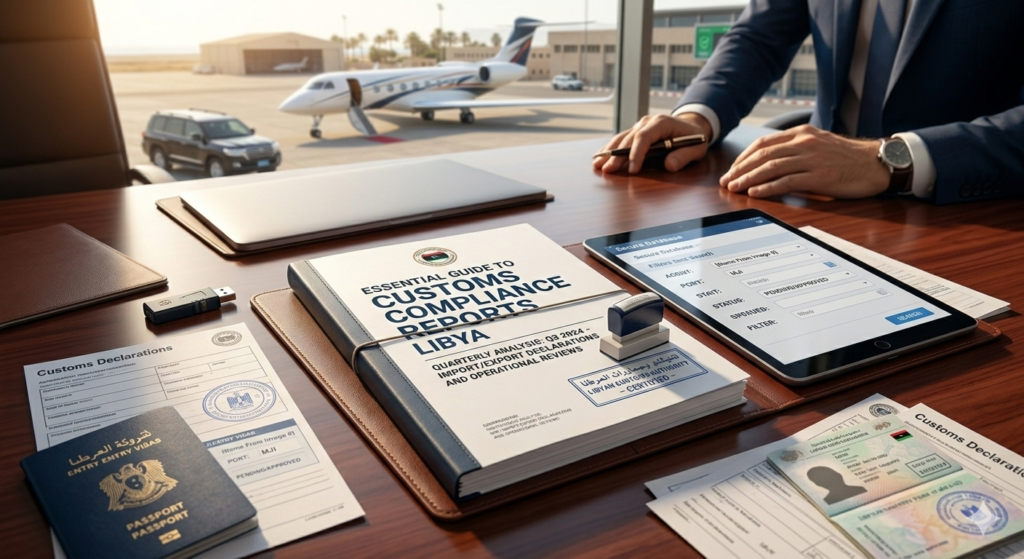
Imagine your container sitting at the Port of Misrata for weeks. Demurrage fees pile up daily. Your client is furious. Meanwhile, your competitor’s goods clear customs in 48 hours flat.
What’s the difference?
They invested in proper customs compliance reports Libya requires, and you didn’t.
Importing goods into Libya has never been more complex—or more rewarding. Recent regulatory shifts mean authorities now scrutinize every shipment with fresh intensity. But here’s the opportunity: businesses that master compliance sail through while others sink under delays and penalties.
Let’s decode exactly what you need.
What Are Customs Compliance Reports Libya Actually Means
Before diving deep, let’s define our terms. When we discuss customs compliance reports Libya, we’re talking about documented proof that your imports meet every legal requirement set by Libyan authorities.
These reports typically include:
- Verified customs declarations with accurate HS codes
- Proof of tax and duty payments
- ACI (Advanced Cargo Information) registration confirmations
- Import license documentation
- Certificate of origin authentication
Think of them as your shipment’s passport through Libya’s regulatory maze. Without them, your goods don’t move.
Why 2026 Changes Everything for Importers
Libya’s customs landscape shifted dramatically this year. New production and consumption taxes took effect, fundamentally altering cost calculations for importers.
The New Tax Reality
According to recent decisions by Libyan authorities, importers now face tiered tax rates based on product categories:
| Product Category | Tax Rate | Examples |
|---|---|---|
| Essential Food | 2% | Wheat, animal feed, dairy, frozen meat |
| Food Processing | 7% | Sugar, coffee, cooking oils |
| Consumer Goods | 12% | Cleaning products, spare parts, tires |
| Construction & Clothing | 25% | Building materials, furniture, textiles |
| Electronics | 30% | Electronic devices, medium vehicles |
| Luxury Items | 35% | High-end cars, jewelry, tobacco |
Missing these classifications in your customs compliance reports triggers immediate holds.
The ACI Mandate
Starting November 2024, Libyan Customs introduced mandatory Advanced Cargo Information for all containerized imports. Here’s the critical part:
You must obtain an ACI number at least 48 hours before loading. Carriers enforce a strict “NO ACI Number – NO LOAD” policy. Your customs compliance reports must include this number on the Bill of Lading. For official guidance on these requirements, consult the Libyan Customs Authority directly.
Building Watertight Customs Compliance Reports
Creating compliant documentation isn’t rocket science. But it demands systematic attention to detail.
Essential Documents Checklist
Every shipment requires these seven core documents:
- Commercial Invoice: Three originals in English and Arabic
- Packing List: Detailed breakdown of container contents
- Bill of Lading: Original copies for FCL shipments
- Certificate of Origin: Stamped by your local Chamber of Commerce
- HS Code Declaration: Full 8-10 digit tariff classification
- Import License: From Libya’s Ministry of Economy
- ACI Confirmation: Proof of electronic pre-registration
Digital submission through Libya’s Trade Portal accelerates clearance by up to 48 hours.
Cash Declaration Requirements
Travelers and importers should note strict currency rules. Libya now requires declaring all amounts of local or foreign currency when entering or leaving.
Current limits allow:
- Up to 200 Libyan dinars in local currency
- Up to $10,000 in foreign currency (or equivalent)
Exceed these without declaration, and you face customs violations with penalties.
Common Compliance Pitfalls to Avoid
Learn from others’ mistakes. These errors regularly derail shipments.
HS Code Misclassification
Incorrect Harmonized System codes cause approximately 30% of customs holds. Libya requires precise 8-10 digit codes aligned with WCO standards. Construction materials typically fall under HS chapters 68-72.
Always verify through Libya’s customs portal before shipping.
Underestimating Duty Rates
Duties range from 0% to 20% based on product classification. Construction materials often attract 5-10%. But remember—these stack on top of the new production taxes.
Calculate total landed costs including:
- Base duty
- Production/consumption tax (2-35%)
- 10% VAT
- Clearance fees ($500 average)
Missing Import License Requirements
Certain goods demand special permits. Alcohol and pork remain prohibited. Weapons require specific authorization. Always verify restricted items before shipping.
Working with Customs Brokers
You don’t need to navigate this alone. Licensed customs brokers serve as your local experts.
A quality broker:
- Verifies documentation before submission
- Communicates directly with Libyan Customs Authority
- Handles physical inspections (40% of containers face random checks)
- Resolves discrepancies quickly
Choose brokers with accredited status. They reduce clearance risks by up to 60%.
Digital Tools for Compliance Management
Technology simplifies compliance tracking. Modern platforms offer:
- AI-driven document preparation aligned with current regulations
- Blockchain-enabled shipment tracking
- Automated HS code verification
- Real-time regulatory updates
These tools help maintain accurate customs compliance reports without drowning in paperwork.
Frequently Asked Questions
Q: What exactly are customs compliance reports Libya authorities require?
A: They’re comprehensive documentation packages proving your shipment meets all import regulations. This includes invoices, certificates, ACI numbers, tax payment proofs, and HS code declarations.
Q: How do new 2026 taxes affect my customs compliance reports?
A: Your reports must now demonstrate correct payment of production and consumption taxes ranging from 2% to 35%, depending on product category. The Customs Authority won’t release goods without tax payment verification.
Q: Can I prepare customs compliance reports myself?
A: Technically yes. But given the complexity and penalties for errors, most businesses partner with licensed customs brokers or use digital compliance platforms.
Q: What happens if my customs compliance reports contain errors?
A: Expect delays averaging 7-14 days for corrections. You’ll also face demurrage charges around $150 per day after five free days. Severe misdeclarations trigger 20-50% penalties.
Q: How long must I keep customs compliance records?
A: Libyan regulations require retaining approved records for no less than five years, showing production volumes and quantities subject to tax.
Q: Do I need ACI for every shipment?
A: Yes, for all containerized import shipments except personal effects. The system requires pre-registration at least 48 hours before loading.
Conclusion: Master Compliance, Master the Market
Libya’s reconstruction creates massive opportunities. Construction materials, machinery, and consumer goods face surging demand. Oil exports fuel import growth projected at 15% year-over-year.
But opportunity comes with complexity. The businesses that thrive will be those treating compliance as strategic advantage, not bureaucratic burden.
Accurate customs compliance reports Libya requirements aren’t optional—they’re your competitive edge. They mean faster clearance, lower costs, and happier clients.
Ready to streamline your Libya imports?
[Contact our compliance specialists today] for a free documentation review. We’ll identify gaps in your current process and show you exactly how to bulletproof your next shipment.